
From YouTube Character to Toy Shelf: How Small Studios Are Building Real IP in 2026


Most people who start a kids YouTube channel think in terms of views. How many people watched. How the algorithm picked it up. Whether a video went further than the last one. Those numbers matter, but the creators who are building the most durable businesses in kids content in 2026 are thinking about something bigger than views. They are thinking about intellectual property. They are thinking about whether the character at the centre of their content could one day sit on a toy shelf, appear in a book, or feature on the lunch box of a child who has never even watched YouTube.
That shift in thinking, from content creator to IP owner, is one of the most significant trends in kids media right now. Independent creators and small studios are building genuine licensable IP in 2026, and the ones doing it well all share one thing in common: they started with an extraordinary character.
The Shift From Content Creator to IP Owner

The traditional model of kids entertainment was straightforward. A network or studio funded a show, owned the IP, and licensed it to toy manufacturers, book publishers, and clothing brands. The money from licensing often dwarfed the revenue from the show itself. Peppa Pig generates more income through merchandise than through any single platform. The show was never really the product. The character was.
What has changed in 2026 is that the barriers to building original IP have lowered dramatically. A YouTube channel with a consistent, well-designed character and a growing audience is already in possession of an asset. If that character has a clear visual identity, a recognisable personality, and emotional resonance with young children, the path to licensing, merchandise, and multi-platform expansion is no longer a fantasy reserved for the biggest studios.
Bluey showed the world that an independently produced animated character could capture the global children's market without a Hollywood budget. What Bluey had was a character that felt deeply real to children and to parents. That is not a budget question. That is a design and storytelling question, and it is the question every creator building kids content should be asking from day one.
What Makes a Character Actually Licensable

Not every popular character becomes a licensable asset. There are characters who attract millions of views but never translate into anything beyond the screen, and there are characters who build modest but fiercely loyal audiences that turn into thriving merchandise businesses. The difference comes down to a handful of qualities that licensable characters consistently share.
First, they are visually distinctive and reproducible. A licensable character needs to look the same whether it is rendered in full 3D animation, printed on a t-shirt, moulded into a toy, or illustrated in a picture book. Characters with complex designs that only work in one medium are limited in where they can go. Simple, clear, emotionally expressive characters travel further.
Second, licensable characters have a personality that is instantly communicable. In a single image, with no sound and no context, a child who knows the character should feel something. That warmth, that recognition - it has to live in the visual design itself, not just in the animation. This is one of the reasons that 3D character design done well is such a powerful foundation for IP building. A well-designed 3D character exists in three dimensions of expression.
Third, the character needs a world. Not necessarily a complicated one, but a consistent setting, a group of relationships, a visual universe that children can return to and feel at home in. Characters without worlds are harder to license because there is less for manufacturers and publishers to work with. The world is the IP, not just the character alone.
The Pipeline From Screen to Shelf
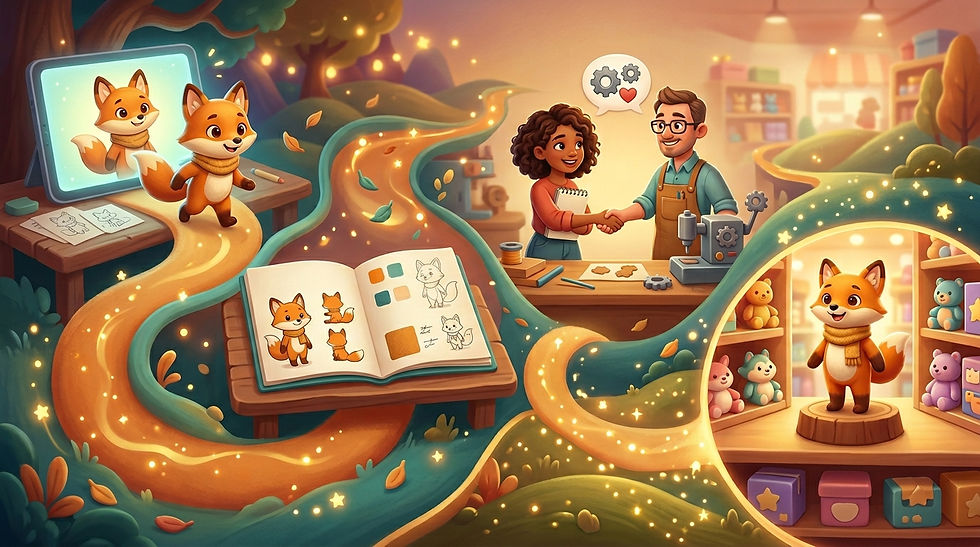
The route from a YouTube character to a toy shelf is more structured than most creators realise. It typically begins with audience proof: data showing that children actively engage with the character, not just watch passively. Comments from parents describing how their child asks for the character by name. Fan art. Children recreating scenes in play. These signals are what licensing agents and manufacturers look for before they invest.
From there, the path moves through brand packaging - a style guide that documents the character's visual identity across every application, from plush toys to digital stickers. Then it moves into conversations with licensing agents or directly with manufacturers and retailers who work in the preschool space. The most successful independent IP deals in 2026 have come from creators who had strong audience proof, a well-documented visual identity, and a clear sense of the emotional territory their character owns.
Projects like the character work behind Bangi Wonderland and SAVG LYF show what it looks like when a character is built with longevity in mind from the very beginning. When the 3D character rigging, the design, and the personality all point in the same direction, the character becomes a lasting asset rather than just a production output.
What This Means for Small Studios and Independent Creators

If you are building a kids YouTube channel or developing a children's animated concept in 2026, the IP conversation is not one to have later. It is one to have before you design the character. Because the decisions you make at the design stage - the character's proportions, their colour palette, the simplicity of their visual identity - will either open or close the door to everything that comes after.
The good news is that building a character with IP potential does not require a bigger budget. It requires more intentional design. It requires asking not just "will this look good in the first episode" but "will this translate to a plush toy, a colouring book, a birthday cake?" It requires thinking about the character as a brand from the very start, and building every design choice to serve that long-term vision.
How Whizzy Studios Helps You Build Characters That Become Real IP
At Whizzy Studios, we have always believed that the characters we build are more than animation assets. They are the beginning of something that can grow far beyond any single screen or platform. That is why our approach to 3D character design places so much emphasis on visual clarity, emotional distinctiveness, and the design decisions that make a character adaptable across mediums.
Whether we are developing characters for a kids TV show, a 3D cartoon series, or an independent YouTube channel, we bring IP-first thinking to every project. Our 3D character rigging and concept art work is built to make characters that are expressive, reproducible, and ready for the full range of opportunities that come with a growing audience.
If you have a character idea that you want to build into something lasting - something that could one day sit on a shelf, appear in a book, or travel into the hands of children who have never seen your channel - we would love to work with you. Get in touch with us and let us start the conversation about what your character could become.


Comments