
How to Get the Most From Your Animation Budget
- Parth Ashara
- 10 minutes ago
- 4 min read


Animation budgets are fixed. Production time is finite. But the impact of what you create doesn't have to be. Whether you're working with a modest budget on your first project or managing a significant investment in a full character series, the decisions you make before a single frame is drawn determine how far your money goes.
At Whizzy Studios, we've worked with clients across a wide range of budgets, and we've seen what separates clients who get exceptional value from their kids animation investment from those who feel like they underspent or overspent. It almost always comes down to decisions made at the start, not the end.
Decide What You're Optimizing For

The single most important question before any animation project is: what do you actually need this video to do? That question sounds obvious, but it's remarkable how often it goes unanswered until production is underway.
If you need a video that converts parents who are already researching your brand, you need clarity and credibility above all else. If you need something that builds awareness among children who don't know you yet, you need entertainment and character. If you need content for an ongoing YouTube channel, you need a scalable format that can be produced efficiently across multiple episodes. Each of these priorities leads to different creative decisions, and different budget allocations.
Defining your primary goal upfront prevents the common trap of trying to make one video do everything. A kids animation video that tries to be an awareness piece, a conversion piece, and a retention piece simultaneously usually succeeds at none of them. Be specific about the one thing you most need, and let that drive the brief.
Where Animation Budgets Actually Go

Understanding where your money goes helps you make smarter tradeoffs. In most kids animation projects, the budget divides roughly into four areas: script and concept development, character and background design, animation production, and sound (voiceover, music, sound effects).
Script and concept is where the most leverage lives. A well-developed script prevents costly revisions during animation, when changes are significantly more expensive. Investing time and attention at the script stage, even if it adds a week at the beginning, reliably saves money and time across the rest of the project.
Character design is a one-time investment that pays forward. If you're planning more than one video, building a library of designed characters and environments from the start means subsequent videos cost significantly less to produce. The design investment amortizes across everything you make afterward.
Animation production, the actual frame-by-frame work, is typically the largest line item. The primary variables here are runtime, complexity of movement, and number of unique scenes. A 60-second video with simple character movement costs far less than a 90-second video with complex action sequences and multiple unique environments.
Decisions That Save Budget Without Sacrificing Quality

Shorter is nearly always better. Parents and children have short attention spans. A 60-second video that is tightly written and beautifully executed outperforms a two-minute video that drags in the middle. Cutting runtime is often the single highest-impact decision for both quality and cost.
Reuse environments and assets. If multiple scenes happen in the same location, production time drops significantly. Planning your script so that characters return to the same environments across a video, or across a series, lets you invest more in making those environments rich without blowing the budget on one-time locations.
Develop characters before scripting. When the character exists before the script is written, the writer can make choices that match what's easy to animate. A character who primarily reacts to their environment is simpler to animate than one involved in complex physical interactions across every scene. Scripting around your character's design saves production hours.
Plan for a series from the start. If there's any chance you'll want more than one video, design the first project as episode one of a series rather than a standalone piece. The upfront investment in character and world design is the same either way, but the per-episode cost of subsequent videos drops dramatically when the foundation already exists.
Getting More From Your Creative Process
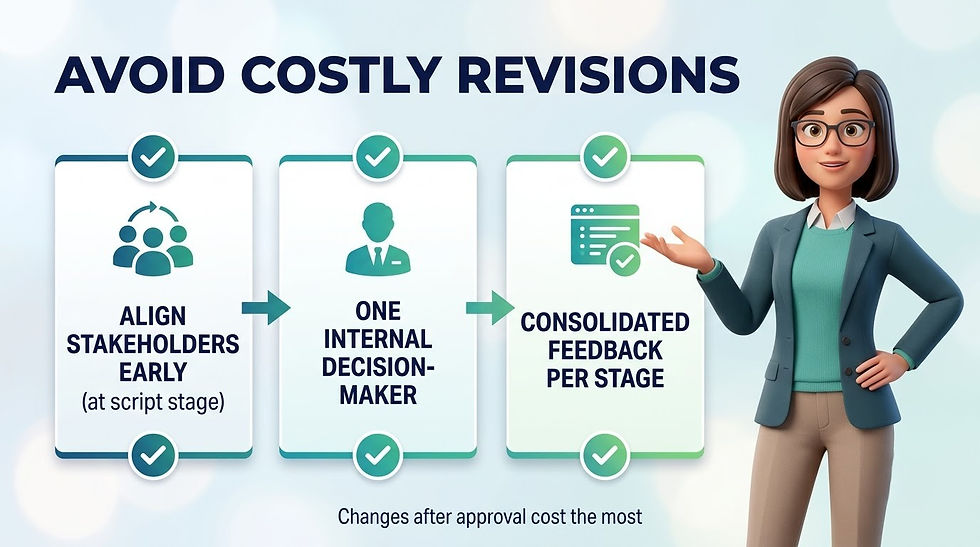
The revision process is where budgets most often overrun. Animation studios charge for revision rounds because changes after approval require re-work at every downstream stage. A change to a character design approved in month one may require adjustments to dozens of scenes already animated by month two.
The most effective clients involve all relevant internal stakeholders at the script and concept stage, before animation begins. Getting everyone aligned on the creative direction early, even if it takes an extra two weeks, prevents the far more expensive scenario of requesting significant changes mid-production.
Providing clear, consolidated feedback at each approval stage also matters. Feedback that arrives in multiple waves from different team members creates confusion and delays. Designate one internal decision-maker for the project and collect all feedback through that person before sending anything to the studio.
Measuring Return on Your Animation Investment
The best way to get more from your animation budget long-term is to measure what works. Track how each video performs, watch time, click-through rate, conversion, shares, or whatever metric matters most to your business. That data tells you which creative decisions drove results and which ones to change in the next project.
Clients who treat animation as an ongoing investment rather than a one-time expense consistently get better returns. The first video establishes the character and the world. The second video does it better. By the third and fourth, you have a content engine that compounds in value with every new piece you produce.
If you're ready to start planning your next kids animation project and want to make the most of your budget, reach out to Whizzy Studios. We'll help you structure the project for maximum impact and long-term value. You can also browse our portfolio to see what efficient, high-quality kids animation looks like in practice.


Comments